The Port of Baltimore is one of the busiest and most strategically significant ports on the East Coast, handling automobiles, bulk cargo, containers, and specialized military and government shipments through terminals that operate around the clock. Governed by the Maritime Transportation Security Act (MTSA) and the TSA’s Transportation Worker Identification Credential (TWIC) program, the port’s secure areas require all personnel to hold a valid TWIC card or be accompanied by a TWIC-authorized escort at all times.
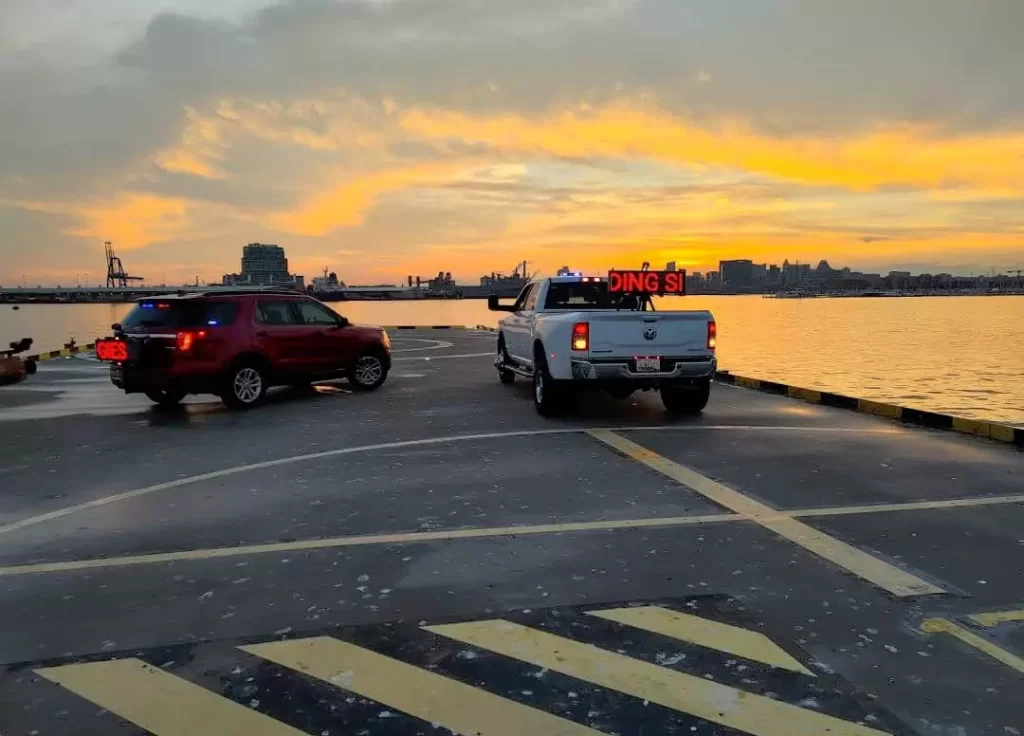
TWIC escort work at the Port of Baltimore is one of OPPS’s signature operational disciplines. Our escort personnel work the port daily, meeting non-credentialed drivers, contractors, and response personnel at designated entry points, verifying identification, delivering the required security briefing, and supervising movement through restricted areas to the destination and back. That daily presence gives our team a working knowledge of the port’s terminals, checkpoints, access roads, and operational staff that an occasional provider simply cannot replicate.
The Port of Baltimore TWIC escort portfolio includes three distinct assignment types: routine escort operations for non-credentialed commercial drivers picking up and delivering cargo, high-value military equipment transfer escorts in restricted areas prior to overseas shipment, and emergency escort operations for critical response personnel, including the HEPACO hazardous material response escort conducted during a snow storm.
TWIC escort work at the Port of Baltimore operates under a specific and non-negotiable compliance framework, and that framework does not flex for convenience, weather, or schedule pressure.
For all escort personnel is the baseline, authorizing the escort to enter restricted areas and accompany non-credentialed individuals through them
At the designated meeting point before any movement into the restricted area begins, with confirmation of the individual’s identity, purpose, and destination
Delivered to all escorted personnel covering the restricted area’s rules, designated pathways, PPE requirements, and prohibited conduct before entry
From entry through the restricted area to the designated destination and back to the exit point, with the escort remaining responsible for the non-credentialed individual’s conduct throughout
Of each escort engagement for the port’s access records and the client’s compliance file
Matching the port’s operational schedule, including overnight arrivals, vessel windows, and emergency deployments that cannot wait for business hours
Routine Commercial Escort Operations
The most frequent TWIC escort engagement at the Port of Baltimore involves non-credentialed truck drivers picking up or delivering cargo. Most out-of-region drivers do not hold TWIC cards, and federal regulations prohibit them from entering secure areas without escort. OPPS provides scheduled and on-call escort coverage that keeps freight moving: meeting drivers at the gate, completing the verification and briefing procedure, and guiding them to their terminal by the most efficient compliant route.
Military Equipment Transfer Escorts
OPPS has secured high-value military equipment transfers in restricted Port of Baltimore areas prior to overseas shipment, as documented in the SEKO Technology case study. These engagements require TWIC-certified personnel with the composure and professionalism that military and government equipment transfers demand, coordinated with port operational staff and conducted in the restricted areas where the equipment stages before departure.
Emergency Response Escorts
When HEPACO’s hazardous material response teams needed access to the Port of Baltimore during an active snow storm to begin environmental cleanup operations, OPPS executed the secured emergency escort under conditions that compressed the normal planning timeline and added active winter storm logistics. Emergency escort at the Port of Baltimore is the hardest version of the assignment: the same TWIC compliance requirements, the same restricted area procedures, and none of the lead time. That engagement is documented separately in the HEPACO case study.
Maintained at the Port of Baltimore across daily commercial escort, military transfer, and emergency response assignments
Delivered on every escort engagement, including credential verification, security briefing, and continuous supervision through restricted areas
Secured in restricted port areas prior to overseas shipment, as documented in the SEKO Technology case study
Familiarity built through daily operations, giving OPPS escort personnel the terminal, checkpoint, and access road knowledge that emergency and time-sensitive escorts depend on
Port escort is a specialty, not a general security assignment. The combination of TWIC certification, working knowledge of the port’s terminals and checkpoints, experience with the full spectrum of escort types from routine commercial to emergency response, and the ability to perform under pressure when an environmental crisis or military shipment window is the context, is not something a new provider assembles quickly.
OPPS has earned that combination through daily operations at the Port of Baltimore. Our escorts are not learning the checkpoints on your driver’s time. They are running routes they have run before, at gates they know, with port staff they work with regularly. That familiarity is what gets a TWIC escort done correctly, efficiently, and compliantly every time.